

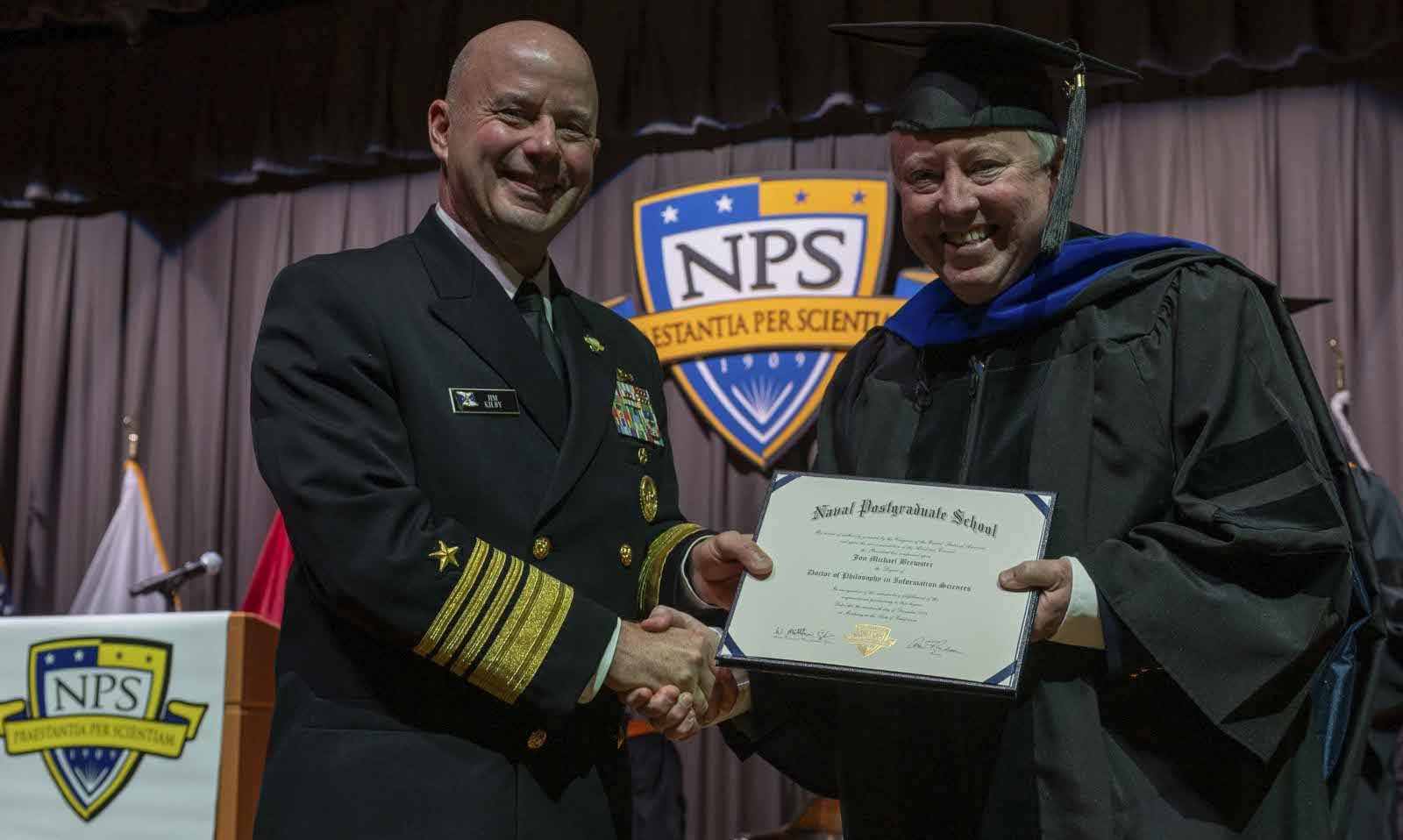
Jon Brewster, Ph.D. Dissertation, December 2025
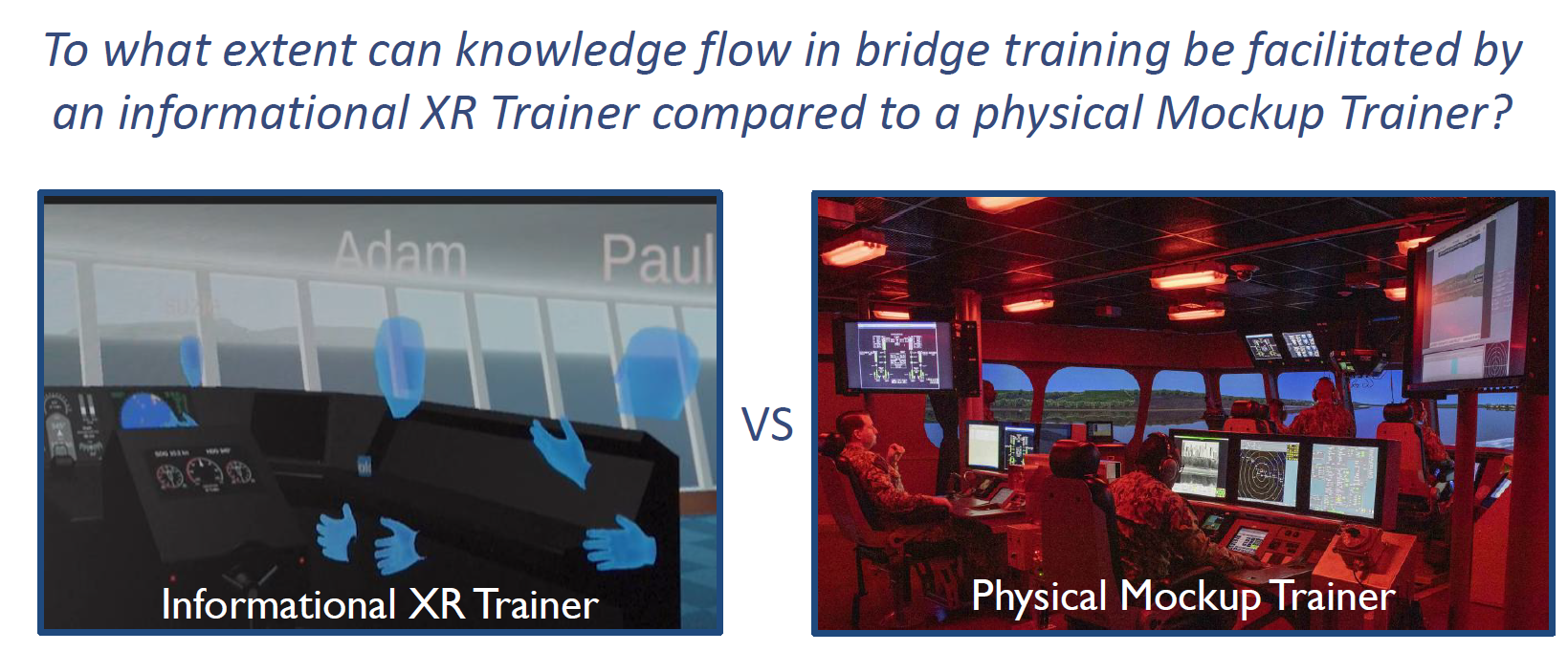
Abstract. Tacit knowledge—embodied, situational, and difficult to articulate—plays a critical role in U.S. Navy bridge operations, yet it remains challenging to transfer through resource-limited mockup training. This dissertation evaluated whether extended reality (XR) could support tacit knowledge flow by comparing XR-based team training to the Navy’s Navigation, Seamanship, and Shiphandling Trainer (NSST). Sponsored by the Office of Naval Research Tech Solutions and executed by Naval Information Warfare Center, Pacific, this study compared more than 17,000 data points taken from 28 bridge teams (158 participants) who completed matched scenarios in both XR and the NSST. A within-subjects design supported over 300 statistical tests, including Wilcoxon and Mann-Whitney analyses, Hotelling’s T², Cohen’s d effect sizes, order effects, subgroup analyses, principal component analysis, sentiment analyses, and distributional fitting. Across the NASA Task Load Index, System Usability Scale, and Bridge-Watch Self-Assessment results supported three of four hypotheses, showing XR produced workload, usability, and readiness outcomes comparable to the NSST. Research findings demonstrated XR is a viable, portable, always-available training solution usable from any location at any time and also advances Knowledge Flow Theory toward future investigations into “Cognition in the Virtual,” a new conceptual framework for tacit knowledge flow via synthetic experience across mixed reality environments.
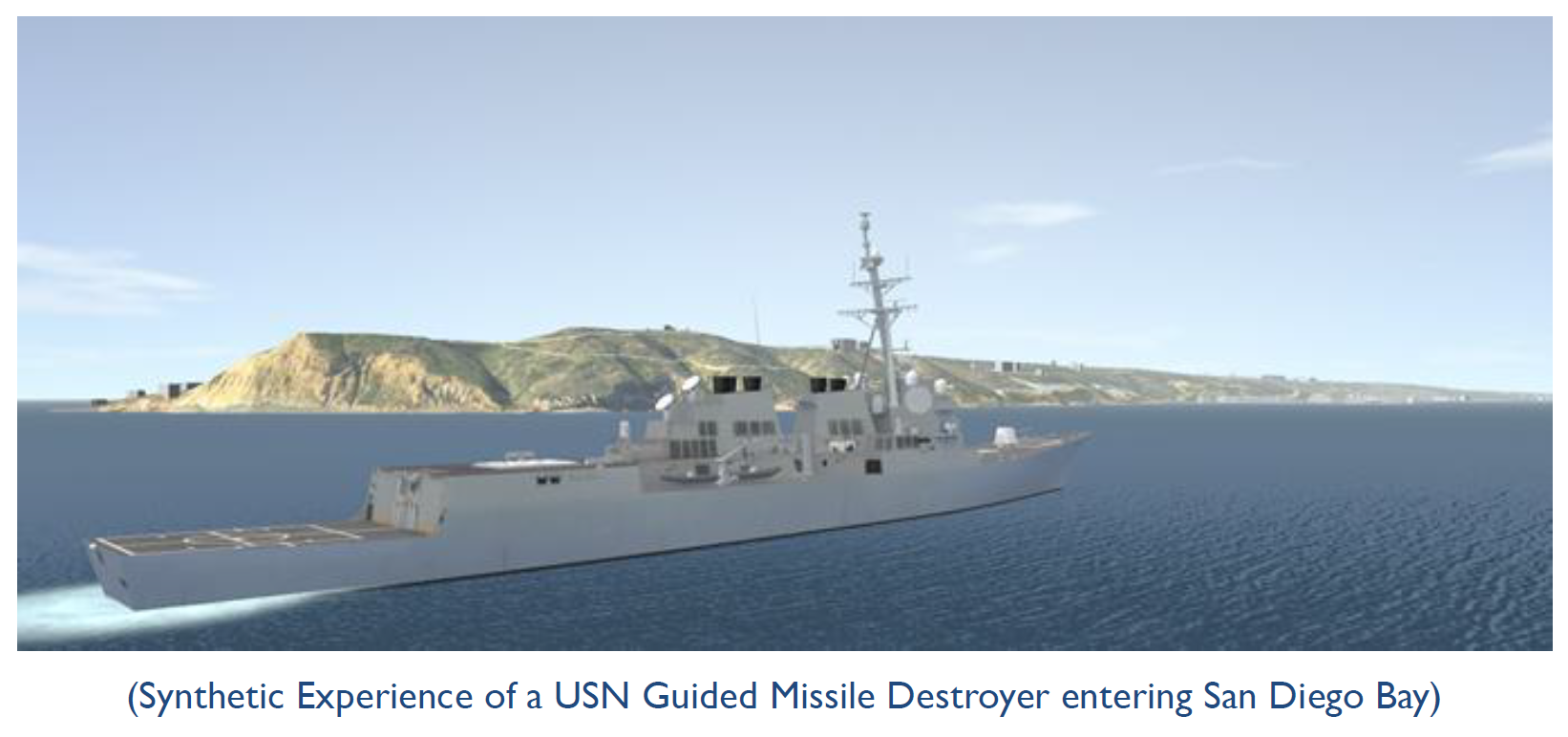
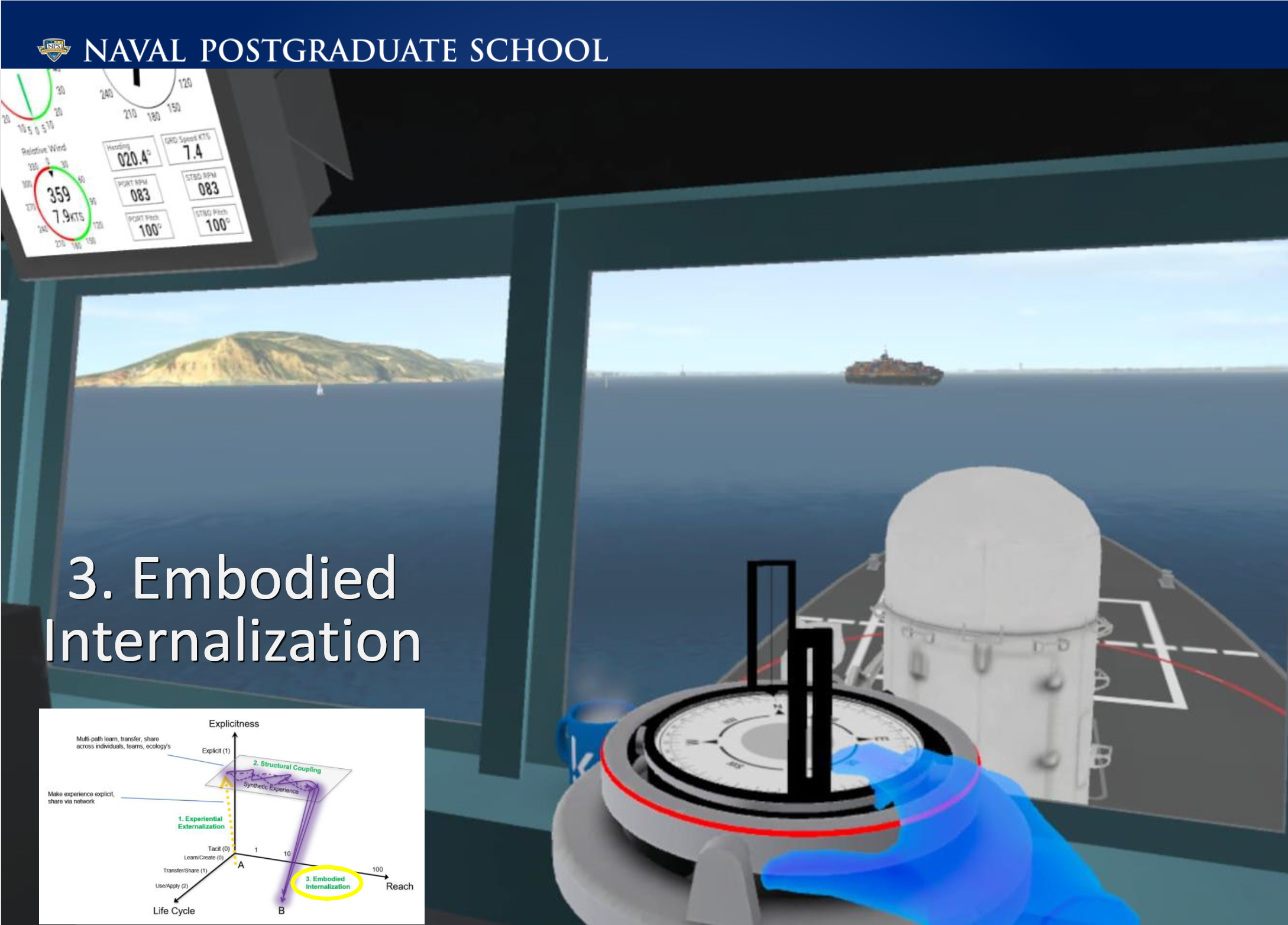
Research Summary. This study demonstrated that XR-facilitated synthetic experience can serve as a viable interactive attentional terrain for auditory, visual, and limited haptic modalities when properly mapped to a real-world embodied task. This was particularly well suited to Navy bridge watchstanding because the tacit knowledge investigated was spatiotemporal; for example, subjects’ body positions in XR matched real-world analogs, and tactile interaction was subordinate to auditory and visual cues.
 |  |  |
Knowledge Flow, defined
- Knowledge is operationalized as “know how”, it enables direct action.
- In Knowledge Management, such “know how” can exist in three forms: ‘Tacit’, ‘Implicit’ or ‘Explicit’ where explicitness refers to knowledge which has been informed in a medium as information.
- Knowledge Flow chiefly concerns the movement of explicit knowledge from “…how, when, and where it exists to how, when, and where it is needed” (Nissen, 2014). In this conception, knowledge flows begin as expertise of ‘those who know’, either as tacit or implicit knowledge, which is then (a) made explicit as information, (b) conveyed to ‘those who do not know’, and (c) informed as “know how” in the minds of the receiver.
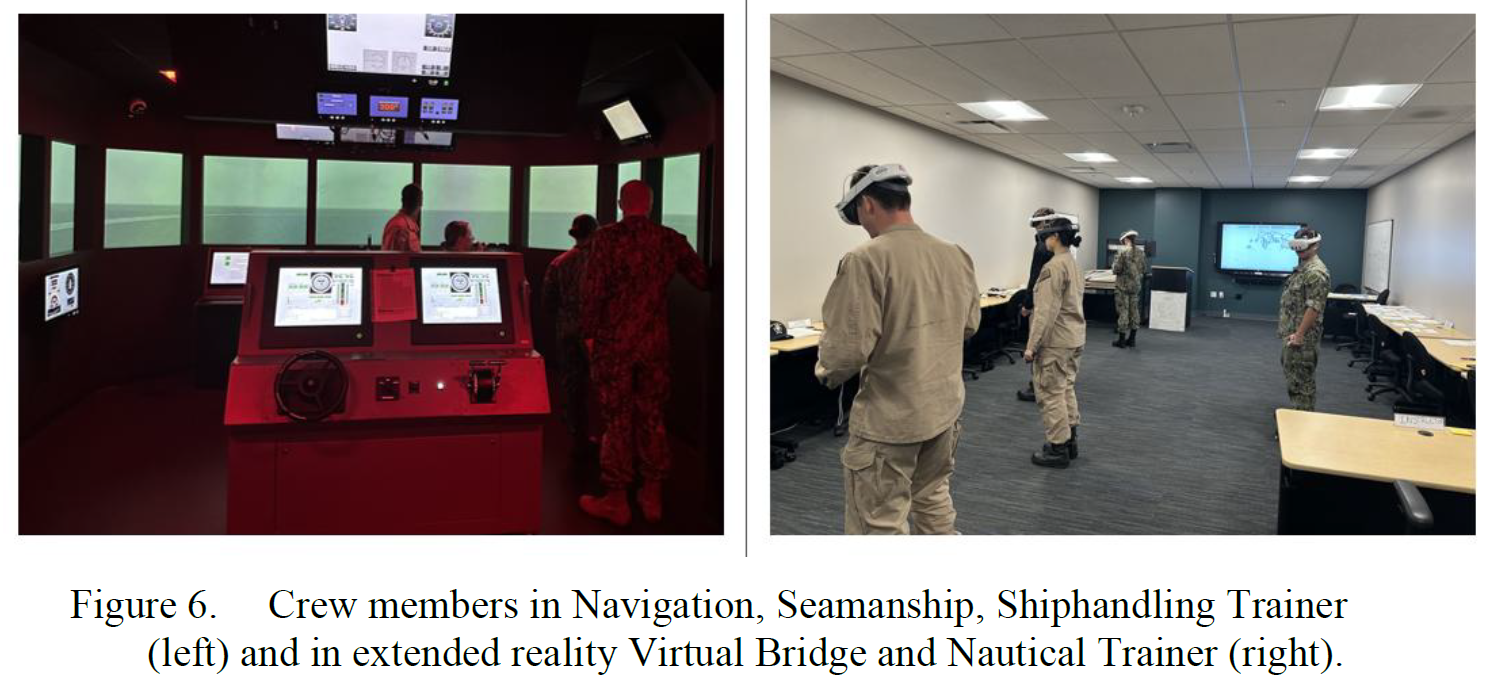
Thus, in general, the effectiveness of Knowledge Flow can be measured. Team training in ship simulators facilitates knowledge flow, for individuals and groups.
Knowledge Friction, defined
“The delaying or loss of knowledge after it has been collected and imparted by the organizational communicator in the transfer link to the designated recipients; it is the cause of the loss of knowledge between the knowledge transmitter and the knowledge receiver.”
- as defined by Nissen (2019) and extended by Shigley (2021)
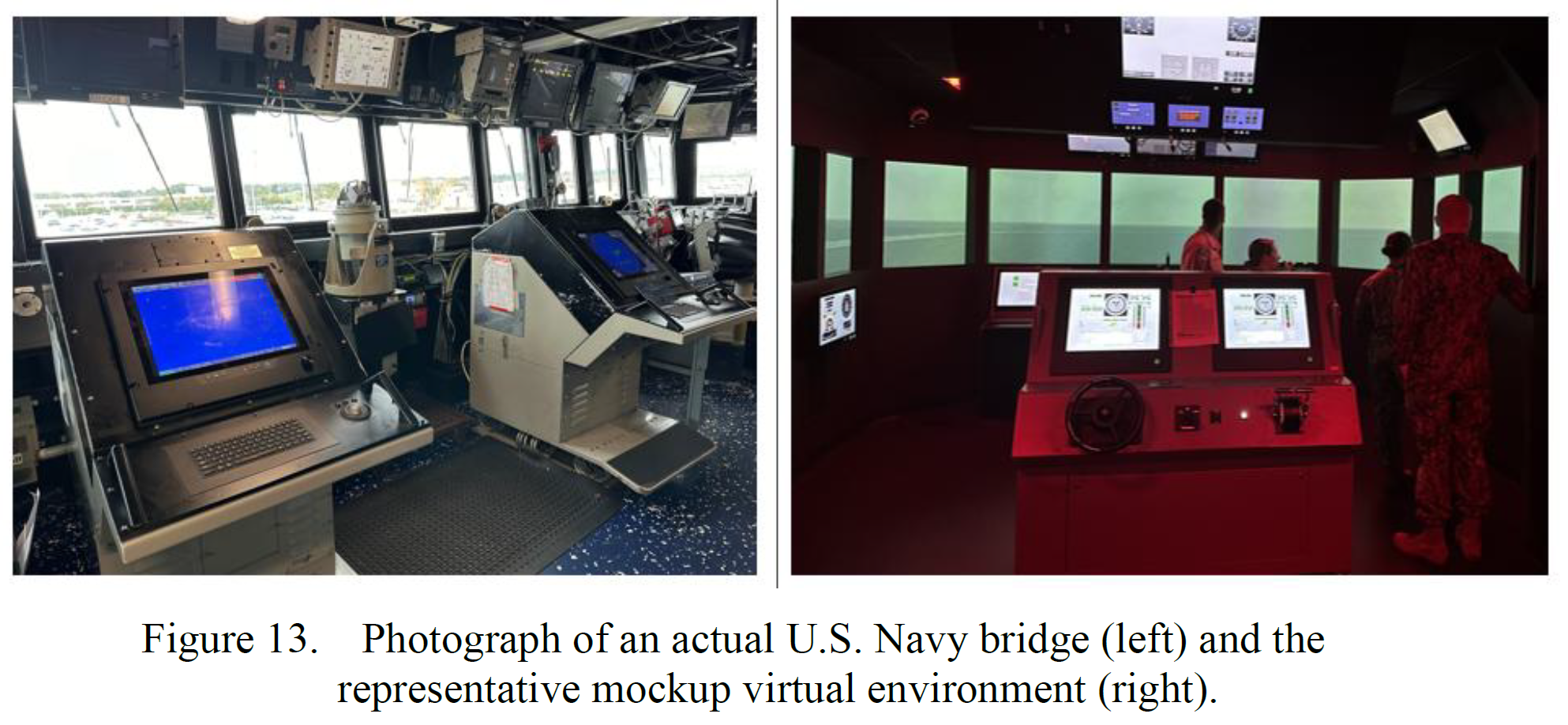
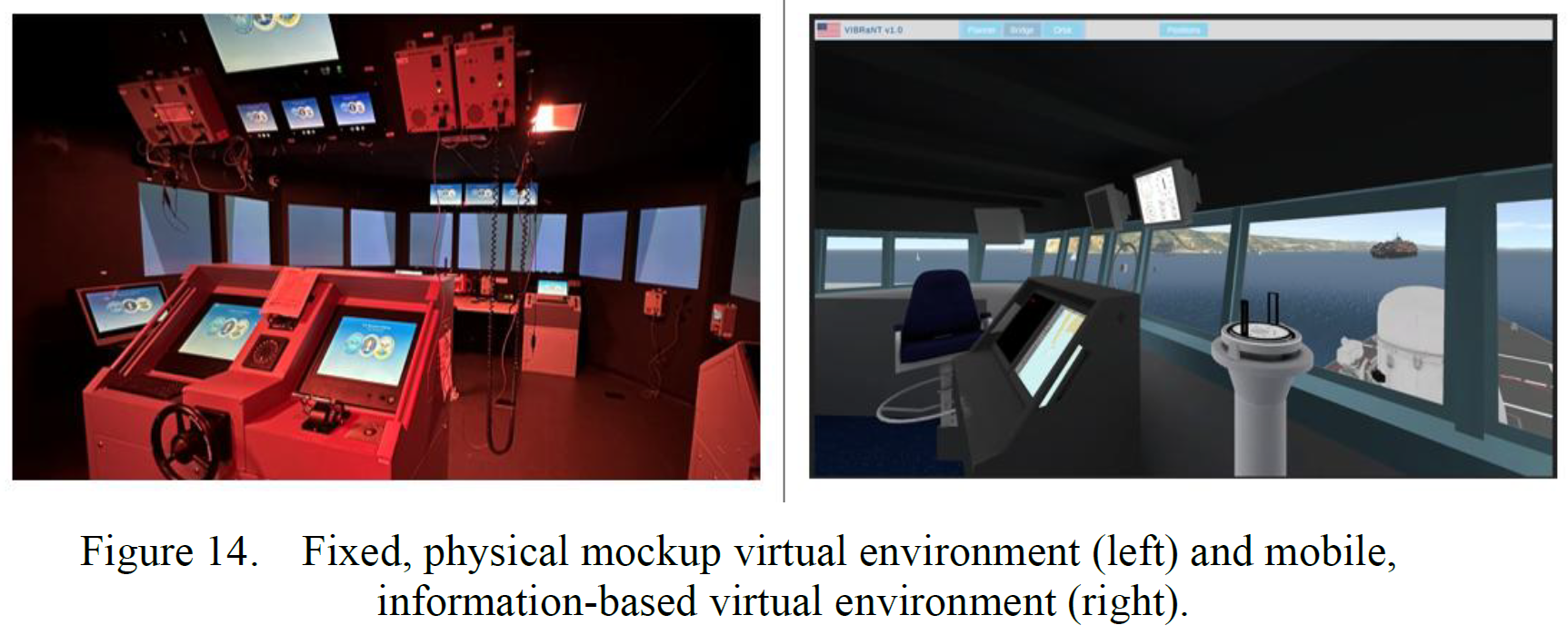
XR represents a novel transfer link compared to a physical mock-up simulation, impacting explicitness, reach, and power.
Key Findings
- H₁ – Knowledge Flow facilitated via XR WILL (for mapped skills and tasks) be greater than or equal to the facilitation provided via a Mockup Trainer. Largely Supported, further research needed.
- H₂ – Extraneous Cognitive Load produced by XR WILL (for mapped skills and tasks) less than or equal to the extraneous cognitive load of the Mockup. Supported for most Bridge Watch Station (BWS) Tasks.
- H₃ – Facilitation of critical Situational Awareness (SA) skills via XR WILL be greater than or equal to the SA skills facilitation via a Mockup Trainer. Largely Supported, further research needed.
- H₄ – Performance in the Mockup WILL, when preceded by XR training sessions, be greater than or equal to knowledge flow facilitation in the Mockup when NOT preceded by XR. Minor Order Effects, but those found improved perception of mockup performance, further research needed.
Research Contributions
- Theory: Extends Knowledge Flow and Embodied Cognitive Theory by incorporating concepts of XR-presented synthetic experience as an information medium to flow Tacit Knowledge.
- Method: Adds to the growing body of XR methodologies applied and evaluated for 1st person, team-based experiential learning.
- Practice: Provides the United States Navy an evaluation of XR application to improve the practice of training Navigation, Seamanship, Shiphandling and Bridge Resource Management.
Conclusions
- U.S. Navy bridge team perceptions of XR training were not significantly different than those of the physical bridge mockup.
- XR vastly increases facilitation of Tacit Knowledge Flow, specifically:
- Expert Reach and Training Availability is Virtually Unlimited. Speeds the window from training to engagement.
- Scenarios presented via XR are Virtually Unlimited. Any bridge, any ship, any maritime environment, any set of weather conditions.
- Highly Affordable.
- Highly Portable.
Recommendations for Future Work
- Study Design: system comparison only, future research should consider longitudinal measure of XR knowledge transfer vs mockup trainer.
- Sample Size was low and limited to Pacific Fleet ships, further study should consider larger sample across both coasts and all fleet concentration centers.
- Collection venue limited to classroom, future research aboard ship is recommended to characterize sea state effects of shipboard use.
- Data collection was performed for a very specific U.S. Navy case, which perhaps limits External Validity.
- XR equipment was a low-cost prototype, future research should test with XR with improved VMS, RADAR, and RT representations and interactions.
Resources
- Dissertation document and presentation slideset, December 2025
- Calhoun Digital Archive, Dudley Knox Library, Naval Postgraduate School (NPS), December 2025
- Jon Brewster, “Embodying Knowledge Flow: The Collision of Synthetic Experience and the Real World” with presentation, 59th Hawaii International Conference on System Sciences (HICSS), January 2026
- Jon Brewster, “To Reality and Beyond: Employing XR to Facilitate Tacit Knowledge Flow,” 58th Hawaii International Conference on System Sciences (HICSS), January 2025
References
- Hutchins, Edwin, Cognition in the Wild, MIT Press, Cambridge Massachusetts USA, 1995.
- Nissen, Mark, Publications.
- Parkin, Andy, Kilo Solutions for Transformational Maritime Training, London United Kingdom.
- Shigley, Paul, Conceptualizing Knowledge Friction, Ph.D. Dissertation, Naval Postgraduate School (NPS), Monterey California USA, September 2021.
Acknowledgement. Dr. Brewster expresses his deepest gratitude to Dr. Brutzman for his mentorship in completing this research, and his continuing support in furthering exploration into three-dimensional virtual environment applications for knowledge transfer, situational awareness, and decision superiority.
